How to Propagate String of Turtles (Easy Cuttings)
Learn how to propagate string of turtles from stem cuttings: what to cut, how to root them, how long it takes and how to fix rot. Easy and cheap.
In this guide
- What you'll need
- When to take string of turtles cuttings
- How to propagate string of turtles from stem cuttings
- Step 1: Fill the pot
- Step 2: Take the cuttings
- Step 3: Remove the lowest leaves
- Step 4: Dip in rooting hormone (optional)
- Step 5: Plant the cuttings
- Step 6: Add humidity
- Step 7: Give it light and keep it barely moist
- Step 8: Check for roots and pot up
- Can you propagate string of turtles from a single leaf?
- Troubleshooting
- Caring for your new plants
- Frequently asked questions
- Can you propagate string of turtles in water?
- How long does string of turtles take to root?
- Do I need rooting hormone?
- What is the best time to propagate string of turtles?
- Is string of turtles safe for pets?
- Sources
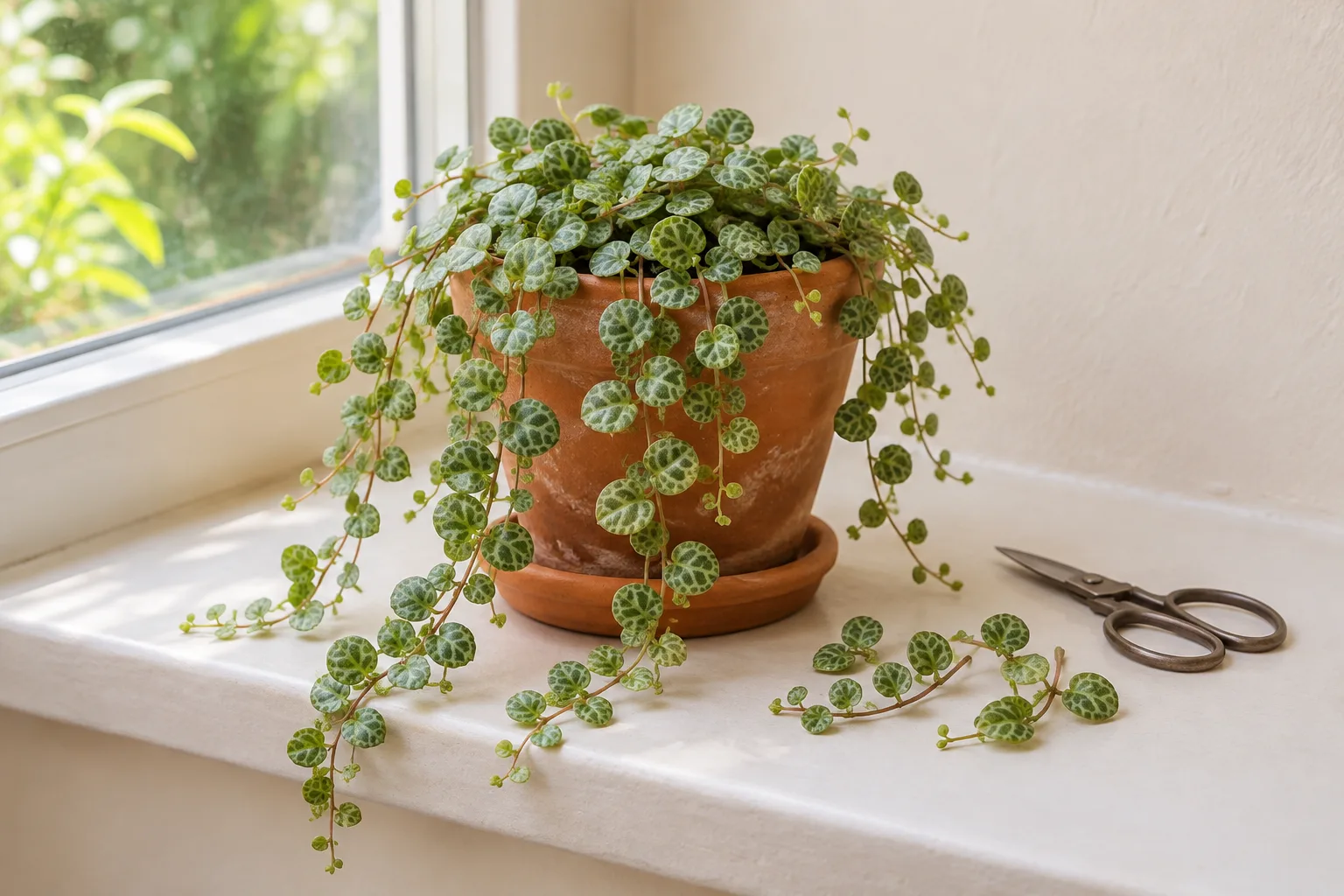
The easiest way to propagate string of turtles (Peperomia prostrata) is with stem cuttings: snip 3- to 5-inch pieces, strip the lowest leaves, and press them into a light, well-drained mix kept barely moist in bright, indirect light. Roots usually take a few weeks, and a couple of trimmings from one plant can fill a second hanging pot for next to nothing.
At a glance
- Time
- about 15 minutes to take and plant the cuttings, then roughly 3 to 6 weeks (sometimes longer) to root
- Difficulty
- Easy
- Approx. cost
- about $0 to $15, depending on what you already own (prices vary)
- Best for
- string of turtles (Peperomia prostrata), also called trailing peperomia
What you'll need
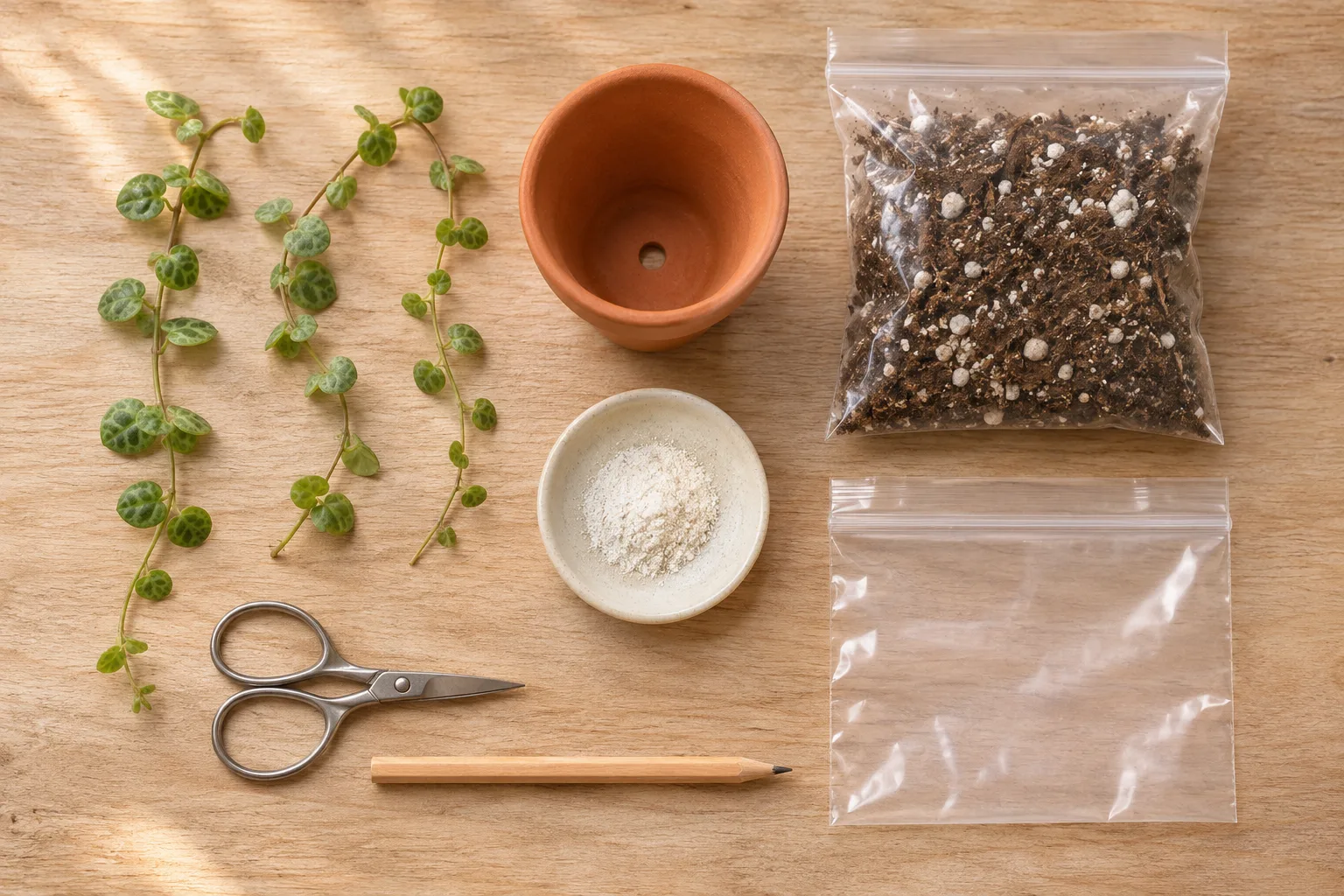
- A healthy, pest-free string of turtles to take cuttings from
- Clean, sharp scissors or small snips
- A small pot (3 to 4 inches) with drainage holes
- Light, well-drained mix, such as a bagged houseplant or cactus mix, lightened with extra perlite
- Rooting hormone powder (optional)
- A pencil or chopstick to make planting holes
- A clear plastic bag or dome, plus a few chopsticks or straws to hold it up (optional)
- A bright windowsill out of direct sun, or a grow light
When to take string of turtles cuttings
Iowa State Extension notes that early spring is the ideal time to propagate by cuttings, though most houseplants can be propagated year-round. If your plant looks leggy or has long, trailing strands, a trim is a good excuse to start new plants at the same time.
Choose healthy, firm strands with plenty of leaves and no spots or pests. NC State's plant database says this plant does best in bright, indirect light and temperatures of about 68 to 75°F, so give your cuttings similar conditions.
Want more windowsill propagation projects? See our guides to propagating a rubber tree plant and propagating a fiddle leaf fig.
How to propagate string of turtles from stem cuttings
Step 1: Fill the pot
Fill the pot with your light mix, water it, and let the extra drain away. The mix should feel evenly damp, like a wrung-out sponge, and never soggy. Clemson Extension says overwatering and root rot are the most common problems for peperomias, so a mix that drains quickly really matters.
Step 2: Take the cuttings
Cut a 3- to 5-inch piece of stem, just below a leaf node (the small bump where a leaf joins the stem). Clemson Extension recommends this length for peperomia stem cuttings. Take several cuttings if you want a full pot.
Step 3: Remove the lowest leaves
Gently pinch off the leaves on the bottom third of each cutting, which Clemson Extension also advises. The bare nodes are where you want roots to form, and leaves left under the mix will rot. The leaves are tiny, so use your fingertips.
Step 4: Dip in rooting hormone (optional)
If you like, dip the cut end in a small amount of rooting powder and tap off the extra. South Dakota State University Extension says you only need a small amount on the cut surface, and tipping a little into a separate dish keeps the main container clean.
Step 5: Plant the cuttings
Poke a hole with a pencil, set the cutting in so at least one bare node is below the surface, and firm the mix gently around it. Plant a few cuttings around the edge of the pot so the new plant fills out evenly.
Step 6: Add humidity
Cuttings root best with high humidity. Iowa State Extension says to enclose the pot in a plastic bag or dome but keep it unsealed for air exchange, and South Dakota State University Extension suggests opening the bag a little if condensation gets heavy. Hold the plastic off the leaves with chopsticks or straws, and open it for a few minutes every few days.
Step 7: Give it light and keep it barely moist
Set the pot where it gets bright, indirect light, or under a grow light. Direct sun can scorch cuttings, and under a bag it can overheat them quickly. Water only when the surface starts to dry, because soggy mix is what rots cuttings.
Step 8: Check for roots and pot up
South Dakota State University Extension suggests giving a cutting a gentle tug after a few weeks: resistance means roots are forming, and new leaves are another sign. Extension guides give about 2 to 6 weeks for many houseplant cuttings, and a small, slow plant like this one can take longer, so be patient. Once the cuttings are rooted and growing, remove the cover and treat them like the parent plant: bright light, and water when the top of the mix has dried.
Can you propagate string of turtles from a single leaf?
NC State's plant database lists leaf cuttings as the recommended propagation method for this plant, and Iowa State Extension lists peperomias among the plants that can be grown from leaf-and-petiole cuttings. In practice, though, the leaves are tiny and the leaf stalk is very short, so single leaves are hard to handle and slow to produce a plant. Stem cuttings with several leaves and nodes are the more reliable choice, and they give you a fuller plant sooner. If you want to try a leaf, press it into damp mix with its stalk just below the surface and treat it like a stem cutting, with high humidity and bright, indirect light.
Troubleshooting
| Problem | Likely cause | What to do |
|---|---|---|
| Stem turns black or mushy at the base | Mix too wet or poor airflow | Discard it, take a fresh cutting, use a lighter mix and open the cover more often |
| Leaves drop or shrivel | Mix dried out, too much sun, or overwatering | Check the mix; water only if the top is dry, and move to bright, indirect light |
| Mold on the mix | Cover left sealed, stagnant air | Take off the cover, scrape off the mold and let the surface dry slightly |
| Nothing seems to happen | Still early, or too cool or dim | Wait a few more weeks and move to a warmer, brighter (not sunny) spot |
Caring for your new plants
Once rooted, give your plants a well-drained houseplant or cactus mix, bright indirect light and water when the top of the mix has dried, as Clemson Extension recommends for peperomias. NC State notes that string of turtles tolerates being pot-bound, so a small container is fine. Several rooted cuttings in one pot will fill out faster than a single strand.
Frequently asked questions
Can you propagate string of turtles in water?
Extension sources don't cover water rooting for this species. A well-drained mix is the safer choice because string of turtles is prone to rot when kept too wet.
How long does string of turtles take to root?
Plan on roughly 3 to 6 weeks, and longer in cool or dim conditions. Extension guides give 2 to 6 weeks for many houseplant cuttings, and this plant is small and slow-growing.
Do I need rooting hormone?
No. Rooting hormone is optional. If you use it, a small amount on the cut surface is plenty.
What is the best time to propagate string of turtles?
Early spring is ideal, according to Iowa State Extension, but you can take cuttings year-round if you can give them bright light and warmth.
Is string of turtles safe for pets?
The ASPCA lists trailing peperomia (Peperomia prostrata) as non-toxic to dogs and cats.
Sources
- Peperomia prostrata, NC State Extension Gardener Plant Toolbox
- Peperomia Indoor Plant Care and Growing Guide, Clemson Cooperative Extension
- Propagating Houseplants, South Dakota State University Extension
- How to Propagate Houseplants by Leaf Petiole Cuttings, Iowa State University Extension
- Trailing Peperomia, ASPCA Toxic and Non-toxic Plants
More garden ideas
- Garden
DIY Garden Chair Bird Bath: Upcycle an Old Chair
DIY garden chair bird bath turns an old chair into a shallow, bird-safe water station. Easy afternoon project, about $5–$25 plus paint drying time.
- Garden
How to Propagate Poinsettia from Cuttings (and When)
Learn how to propagate poinsettia from stem cuttings: when to take them, how to root them in 3 to 4 weeks, and how to check for plant patents.
- Garden
How to Propagate Aloe Vera From a Leaf (Step by Step)
Want to propagate aloe vera from a leaf? Here is how to cut, callus and plant it, what to expect, and why pups are the more reliable route.