Can You Propagate a Fiddle Leaf Fig? Yes, 2 Ways
Yes, you can propagate a fiddle leaf fig. Learn two easy ways: rooting a stem cutting in water or air layering, with timing and sap safety tips.
In this guide
- At a glance
- What you'll need
- Can you propagate a fiddle leaf fig in water or soil?
- Method 1: Root a stem cutting in water
- Step 1: Choose a healthy stem
- Step 2: Make the cut
- Step 3: Trim the lower leaf
- Step 4: Set it in water
- Step 5: Give it light and fresh water
- Step 6: Pot it up
- Method 2: Air layer a tall, leggy plant
- Step 1: Pick the spot and clear the leaves
- Step 2: Cut a wound in the stem
- Step 3: Apply rooting hormone
- Step 4: Wrap with moss and plastic
- Step 5: Wait for roots
- Step 6: Cut and pot the new plant
- Looking after your new fiddle leaf fig
- Frequently asked questions
- Can you propagate a fiddle leaf fig from a cutting?
- How long does a fiddle leaf fig cutting take to root?
- Do I need rooting hormone to propagate a fiddle leaf fig?
- Is fiddle leaf fig sap or the plant dangerous?
- Sources
Yes, you can propagate a fiddle leaf fig. The easiest way is to take a stem cutting with a leaf and root it in a jar of water, and for a tall, bare plant you can air layer a stem so it grows roots while it is still attached. This guide walks through both, with supplies, timing and the sap safety steps.
At a glance
- Hands-on time
- about 20 minutes for a cutting, about 30 minutes for an air layer
- Waiting time
- roughly 6 to 8 weeks for a water cutting to root, and 3 to 4 months or more for an air layer
- Difficulty
- Easy for cuttings, medium for air layering
- Approx. cost
- Free if you own pruners and a jar. Rooting hormone, sphagnum moss and potting mix usually add roughly $10 to $20, but prices vary
- Best time
- When the plant is actively growing
What you'll need
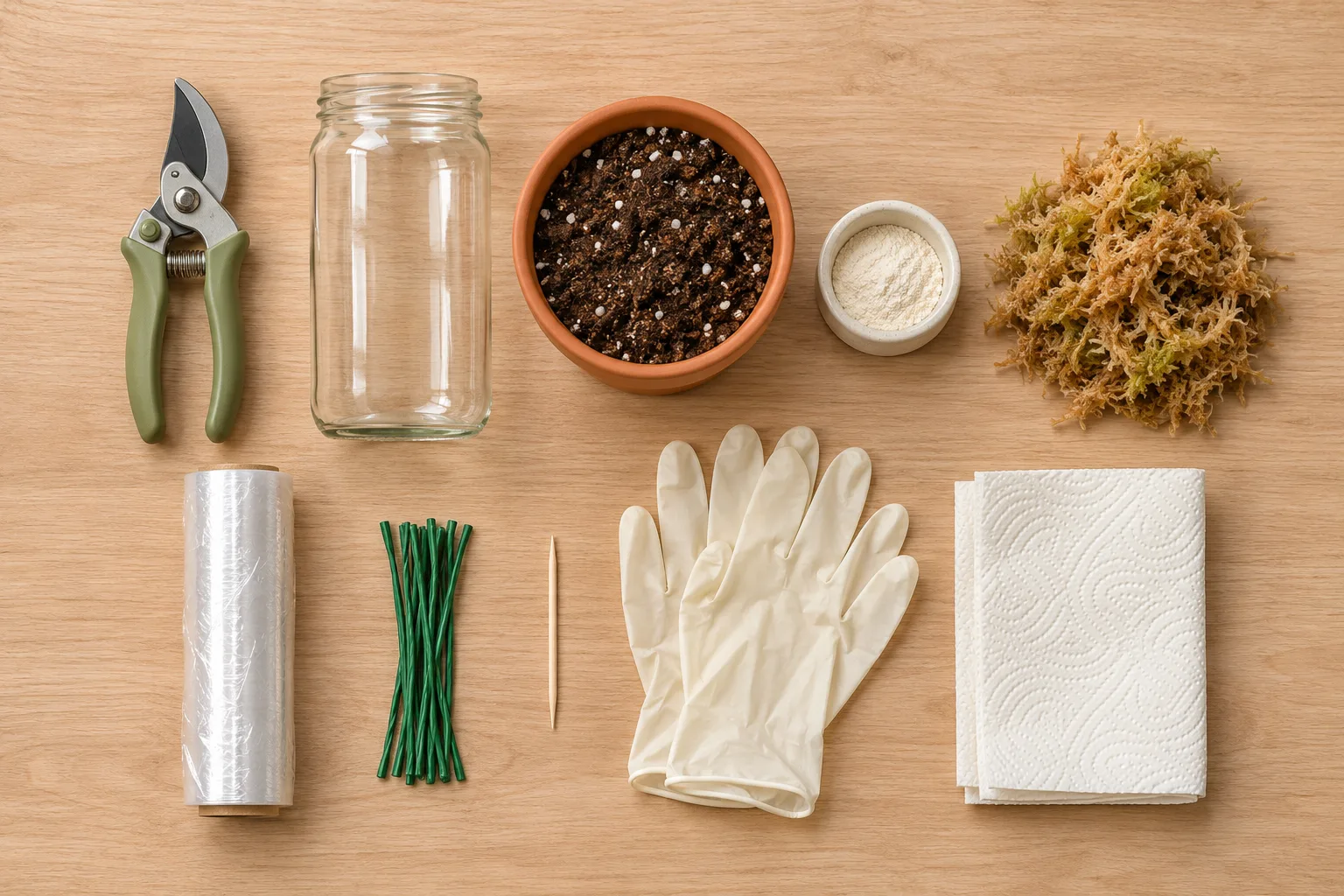
- A healthy, pest-free fiddle leaf fig (Ficus lyrata)
- Clean, sharp pruning shears or a utility knife
- A tall, heavy-bottomed jar or vase (cuttings)
- Room-temperature water (cuttings)
- A small pot with drainage holes and well-drained potting mix
- Rooting hormone powder (optional for cuttings, useful for air layering)
- Moist sphagnum moss, clear plastic wrap and twist ties (air layering)
- A toothpick or matchstick (air layering)
- Disposable gloves and paper towels
Can you propagate a fiddle leaf fig in water or soil?
You can do either. The Old Farmer's Almanac calls rooting in water the most common method, though cuttings can also be rooted in potting mix. NC State Extension's plant database lists stem cuttings as its recommended propagation method for this plant.
| Stem cutting in water | Air layering | |
|---|---|---|
| Best for | Taking a trim from a healthy plant | A tall plant that has lost its lower leaves |
| How it works | A cut stem grows roots in a jar of water | A wounded stem roots in moss while still on the plant |
| Waiting | About 6 to 8 weeks | 3 to 4 months or more |
| Difficulty | Easy | Medium |
Take cuttings from stems that are actively growing. Fiddle leaf figs like bright, indirect light and temperatures above 55 °F, according to NC State Extension, so root your cuttings somewhere warm and bright, away from cold drafts.
Method 1: Root a stem cutting in water
Step 1: Choose a healthy stem
Look for a stem with new green growth, and follow it down to where it turns brown and woody. The Old Farmer's Almanac suggests making the cut just below a node, the bump where a leaf joins the stem. Put on gloves before you cut.
Step 2: Make the cut
Use clean, sharp shears and cut just below a node. Dab the sap from both the cutting and the parent plant with a paper towel.
Step 3: Trim the lower leaf
Take off the leaf at the bottom so the node is bare and can sit in water without leaves rotting. Keep at least one leaf at the top of the cutting.
Step 4: Set it in water
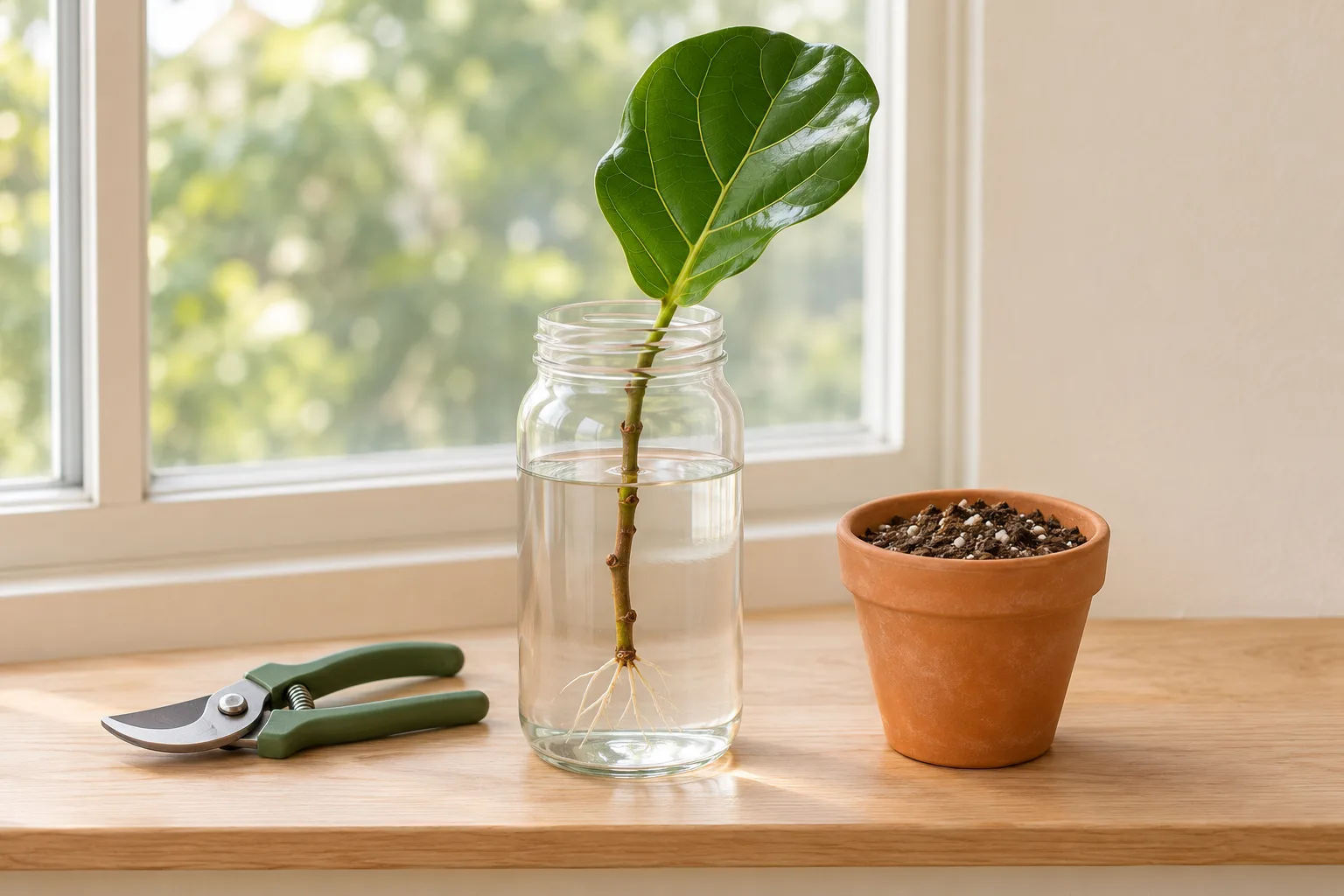
Fill a tall jar with room-temperature water so the node is underwater but the leaves are not. A heavy-bottomed jar helps because fiddle leaf fig leaves are large and can tip a light container. Rooting hormone is optional for water rooting.
Step 5: Give it light and fresh water
Set the jar in bright, indirect light somewhere warm. Change the water weekly, or sooner if it turns cloudy.
Step 6: Pot it up
After roughly 6 to 8 weeks, white roots should appear. The Old Farmer's Almanac says to transplant when the roots are about an inch long. Plant the cutting in moist, well-drained potting mix, and keep the mix moist while the plant gets established.
Method 2: Air layer a tall, leggy plant
University extension guides describe air layering for large-leaved houseplants, because big leaves lose moisture quickly and often do not do well as plain stem cuttings. The roots form while the stem is still attached to the parent plant, so the stem never dries out. A fiddle leaf fig fits that description. The University of Florida's propagation guide says the best results come from actively growing shoots with several leaves.
Step 1: Pick the spot and clear the leaves
Choose a section of healthy stem near the top of the plant. Remove the leaves for a few inches on each side of the spot.
Step 2: Cut a wound in the stem
Wear gloves. Following University of Illinois Extension, make an upward, slanted cut that goes only 1/3 to 1/2 of the way through the stem. Prop the cut open with a toothpick or matchstick. Dab away the sap.
Step 3: Apply rooting hormone
Dust the wound lightly with rooting hormone powder. UF/IFAS says rooting hormones contain auxin, a plant hormone that helps with root development.
Step 4: Wrap with moss and plastic
Press moist sphagnum moss around the wound into a ball about the size of your fist, as University of Illinois Extension describes. Cover it with clear plastic wrap and tie both ends so the moss stays damp.
Step 5: Wait for roots
Check through the plastic every week or two and re-moisten the moss if it dries out. University of Illinois Extension says roots should begin to show through the plastic after 3 to 4 months.
Step 6: Cut and pot the new plant
When roots are visible, take off the plastic, cut the stem just below the new roots, and pot the rooted top in moist, well-drained potting mix.
Looking after your new fiddle leaf fig
Keep the new plant in bright, indirect light and out of afternoon sun, since NC State Extension says the plant needs protection from hot afternoon sun. The same source says it is sensitive to overwatering, so let the pot drain freely and don't leave it sitting in water. For more on the same techniques with other houseplants, see our guides to propagating a rubber tree plant and propagating geraniums from cuttings.
Frequently asked questions
Can you propagate a fiddle leaf fig from a cutting?
Yes. Take a stem cutting just below a node, keep at least one leaf on it, and root it in water or potting mix. NC State Extension lists stem cuttings as the recommended method.
How long does a fiddle leaf fig cutting take to root?
In water, expect about 6 to 8 weeks in bright, indirect light and warmth, according to the Old Farmer's Almanac. Air layers are slower, with roots typically showing after 3 to 4 months.
Do I need rooting hormone to propagate a fiddle leaf fig?
It is optional for a cutting in water. It is a helpful extra for air layering, where UF/IFAS describes applying it to the wound.
Is fiddle leaf fig sap or the plant dangerous?
The sap can irritate skin, and the plant is toxic if eaten, according to NC State Extension. Wear gloves, wash your hands after handling it, and keep cuttings away from pets and children. If a pet chews on it, contact your vet or the ASPCA Animal Poison Control Center at (888) 426-4435.
Sources
- Ficus lyrata (Banjo fig, Fiddle-leaf Fig), NC State Extension Gardener Plant Toolbox
- Fiddle Leaf Fig: How to Grow and Care, Old Farmer's Almanac
- Air Layering, University of Illinois Extension
- Air Layering, PropG, University of Florida IFAS
- Plant Propagation, UF/IFAS Gardening Solutions
- Toxic and Non-Toxic Plants, ASPCA
More garden ideas
- Garden
DIY Garden Chair Bird Bath: Upcycle an Old Chair
DIY garden chair bird bath turns an old chair into a shallow, bird-safe water station. Easy afternoon project, about $5–$25 plus paint drying time.
- Garden
How to Propagate String of Turtles (Easy Cuttings)
Learn how to propagate string of turtles from stem cuttings: what to cut, how to root them, how long it takes and how to fix rot. Easy and cheap.
- Garden
How to Propagate Poinsettia from Cuttings (and When)
Learn how to propagate poinsettia from stem cuttings: when to take them, how to root them in 3 to 4 weeks, and how to check for plant patents.