How to Propagate Aloe Vera From a Leaf (Step by Step)
Want to propagate aloe vera from a leaf? Here is how to cut, callus and plant it, what to expect, and why pups are the more reliable route.
In this guide
- What you'll need
- How to propagate aloe vera from a leaf
- Step 1: Choose a healthy leaf
- Step 2: Cut cleanly and let the latex drip off
- Step 3: Let the cut end callus
- Step 4: Mix a gritty potting mix
- Step 5: Plant the leaf
- Step 6: Water lightly and wait
- Step 7: Check for roots (and be patient)
- What to expect, and when to try pups instead
- Frequently asked questions
- Can you grow aloe vera from a leaf in water?
- How long does it take to propagate aloe vera from a leaf?
- Why is my aloe leaf cutting turning mushy?
- Is aloe vera safe around pets?
- Sources
You can try to propagate aloe vera from a leaf, but it is slower and less certain than separating pups: a leaf may root and sprout a tiny plant, or it may just rot. If you want to try it, the method is simple: cut a healthy leaf cleanly, let the cut end dry and callus for several days, then set it in a gritty, fast-draining mix and keep it barely damp in bright, indirect light. Below are the steps, what to expect, and the more dependable route (pups) in case the leaf doesn't take.
At a glance
Time: About 20 minutes of work, plus 4–7 days of callusing. Rooting and a new plantlet can take a month or two, sometimes longer Difficulty: Medium (easy to do, hard to get right: rot is the usual problem) Cost: About $5–15 if you need a small pot and a bag of cactus mix or perlite (prices vary)
What you'll need
- A healthy, plump, mature aloe leaf from the outer base of the plant
- A clean, sharp knife or razor blade
- A small pot with drainage holes (3–4 inches is plenty)
- Potting mix plus perlite or coarse sand, or a bagged cactus and succulent mix
- A paper towel or plate for callusing
- A spray bottle or small cup for light watering
How to propagate aloe vera from a leaf
Step 1: Choose a healthy leaf
Pick a firm, thick, green leaf from the outside of a mature plant, not a thin, shrivelled or mushy one. Cut it as close to the base of the plant as you can without damaging the rest. Take only one or two leaves so the parent plant keeps plenty of foliage.
Step 2: Cut cleanly and let the latex drip off
Use a clean, sharp blade for a straight cut. The cut will weep a yellow latex that is sticky and smells strong, and the University of Florida's horticulture team notes it bleeds readily from any injury. Lay the leaf on a paper towel and let it drain.
Step 3: Let the cut end callus
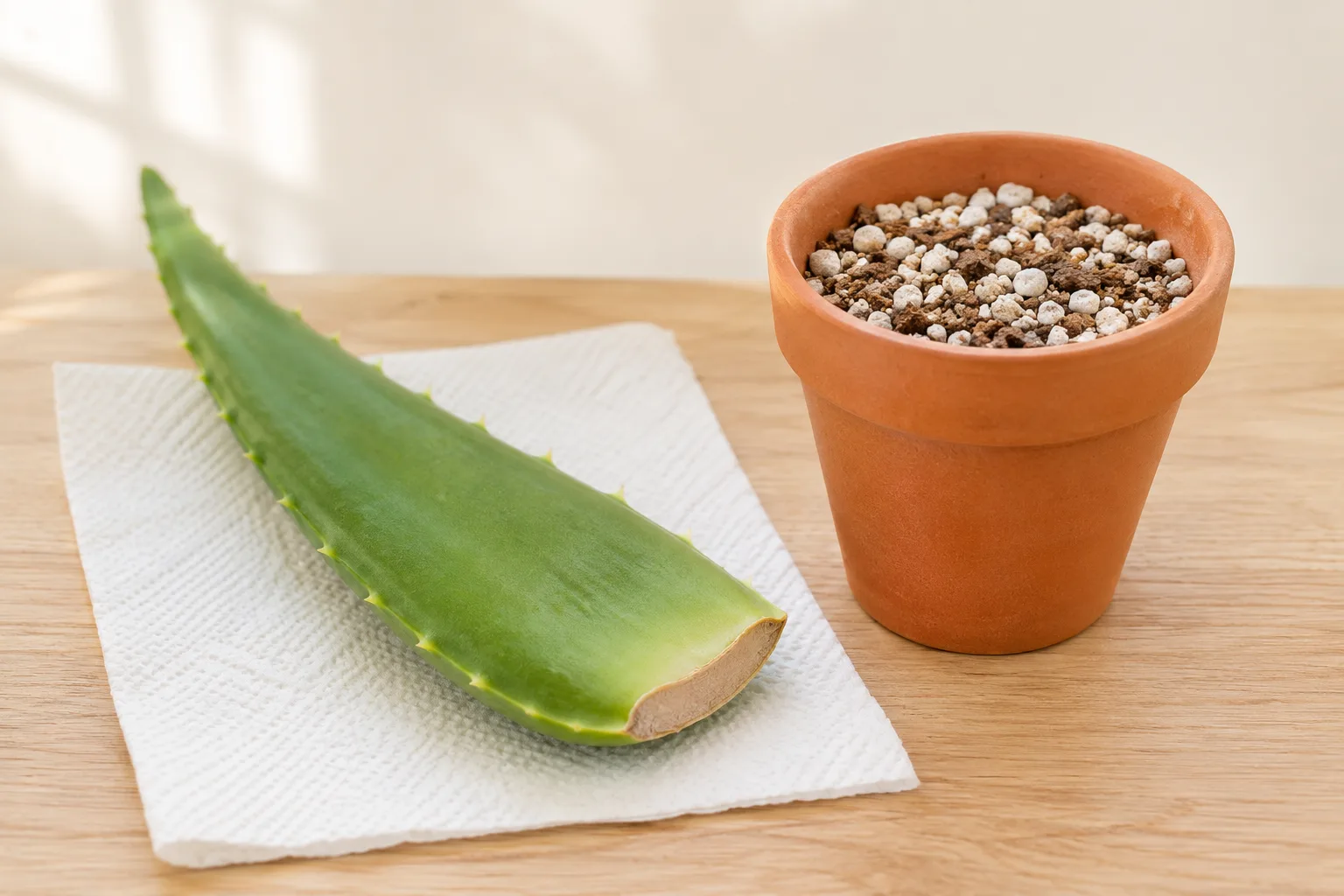
Set the leaf somewhere dry, bright and out of direct sun, and leave it until the cut end has dried over into a firm, dry cap. University of Illinois Extension advises letting succulent cuttings callus for 4–7 days before planting, and UF/IFAS describes a day or two for a leaf cutting. Longer is safer in humid weather. Planting a wet cut end is the quickest way to get rot.
Step 4: Mix a gritty potting mix
Aloe needs a fast-draining mix. Illinois Extension suggests either 1 part potting mix to 1 part perlite, or 1 part coarse sand to 1 part potting mix. A bagged cactus and succulent mix works too. Fill the pot and make sure it has drainage holes.
Step 5: Plant the leaf
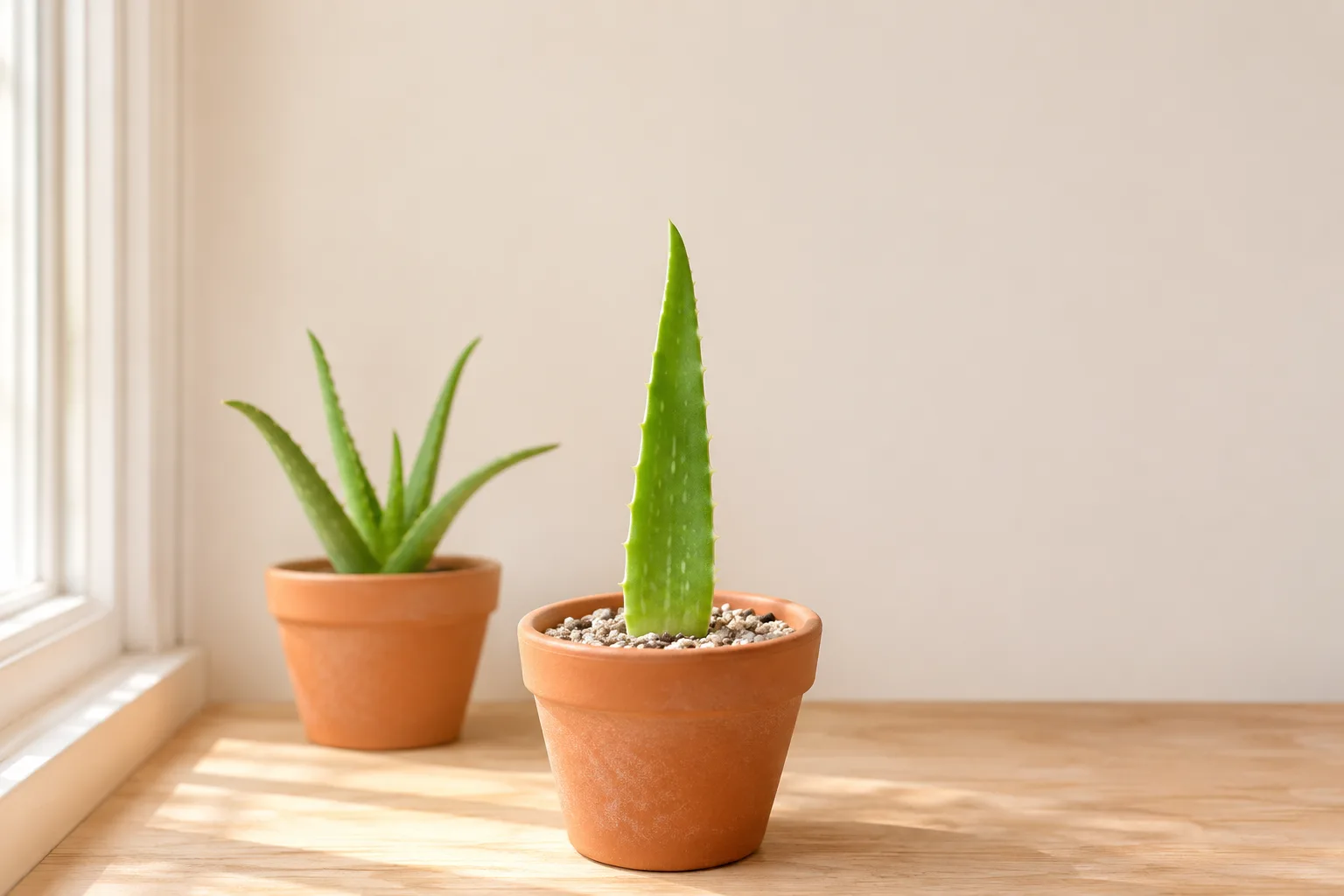
Press the callused end about an inch into the mix, with the leaf standing upright or leaning slightly. If it will not stand up, prop it with a few small stones. Leave the rest of the leaf above the soil.
Step 6: Water lightly and wait
Water sparingly: the mix should be barely damp, never soggy. A leaf has no roots yet and sits in the mix like a cutting, so wet soil mostly gives it a chance to rot. Put it in bright, indirect light. UF/IFAS warns that aloe can sunburn if it is moved from low to bright light too quickly, so avoid blasting a fresh cutting with direct sun.
Step 7: Check for roots (and be patient)
Illinois Extension says a small plant can start to form at the base of a leaf cutting over a month or two. Resist digging it up to check. A slight tug that meets resistance means it has rooted, and a tiny new rosette at the base is the real sign of success. Once it is growing, water only when the top inch or so of mix is dry, as UF/IFAS advises for aloe in general.
What to expect, and when to try pups instead
Be realistic: aloe is naturally a plant that multiplies by offsets, not by leaves. University of Illinois Extension lists aloe as a plant that quickly forms many offsets that are easy to cut or divide from the mother plant and replant. A leaf cutting may rot, shrivel or just sit there, and if the leaf turns soft, brown or mushy, discard it and start again with a fresh leaf.
If you have a mature plant with small "pups" growing around the base, separating those is the more dependable way to get a new plant:
- Gently tip the plant out of its pot and brush the soil away.
- Find a pup with its own roots and, with a clean knife or by hand, separate it from the mother plant.
- Let any cut surfaces dry for a day or two, then pot the pup in the same gritty mix and water lightly.
Propagating other houseplants? See how to propagate a rubber tree plant or propagate a fiddle leaf fig.
Frequently asked questions
Can you grow aloe vera from a leaf in water?
It is not recommended. Extension guidance for succulents is to let the cut end callus and then plant it in a well-draining mix, because a cut end that stays wet is prone to rot.
How long does it take to propagate aloe vera from a leaf?
Allow 4–7 days for the cut end to callus, then roughly a month or two before a small plant may start to show at the base of the leaf. Not every leaf will take.
Why is my aloe leaf cutting turning mushy?
Rot, usually from planting before the cut end calluses, a mix that holds too much water, or watering too often. Discard the leaf, let a fresh one callus fully, and use a grittier mix.
Is aloe vera safe around pets?
No. The ASPCA lists aloe as toxic to dogs, cats and horses, with signs including vomiting, lethargy and diarrhea. If your pet eats some, call your vet or the ASPCA Animal Poison Control Center at (888) 426-4435 (a fee may apply).
Sources
More garden ideas
- Garden
DIY Garden Chair Bird Bath: Upcycle an Old Chair
DIY garden chair bird bath turns an old chair into a shallow, bird-safe water station. Easy afternoon project, about $5–$25 plus paint drying time.
- Garden
How to Propagate String of Turtles (Easy Cuttings)
Learn how to propagate string of turtles from stem cuttings: what to cut, how to root them, how long it takes and how to fix rot. Easy and cheap.
- Garden
How to Propagate Poinsettia from Cuttings (and When)
Learn how to propagate poinsettia from stem cuttings: when to take them, how to root them in 3 to 4 weeks, and how to check for plant patents.