How to Grow Tomatoes Indoors: A Small-Space Guide
Learn how to grow tomatoes indoors: pick a compact variety, use a 5-gallon pot, add light and hand-pollinate. Budget-friendly steps for small spaces.
In this guide
- Pick a tomato that suits indoor growing
- What you'll need
- Step-by-step: how to grow tomatoes indoors
- Step 1: Start seeds (or buy a starter plant)
- Step 2: Give seedlings strong light right away
- Step 3: Pot up into the final container
- Step 4: Light the mature plant
- Step 5: Water and feed
- Step 6: Keep the room comfortable
- Step 7: Hand-pollinate the flowers
- Step 8: Support and harvest
- Common problems
- Frequently asked questions
- Can you grow tomatoes indoors all year?
- How much light do indoor tomatoes need?
- What size pot do indoor tomatoes need?
- Do I have to pollinate tomatoes by hand indoors?
- Which tomato varieties are best indoors?
- Sources
You can grow tomatoes indoors if you give them three things: a compact variety, a big enough pot, and a lot of light. Add a few seconds of hand pollination when the flowers open and you can pick ripe cherry tomatoes from a spare corner, even in winter. This guide covers the cheapest way to set it up.
At a glance
- Time
- about 30–45 minutes to set up, then a few minutes a day. Seed to first ripe fruit takes weeks to months depending on the variety, so check "days to maturity" on the seed packet.
- Difficulty
- easy to medium. Light is the part most beginners get wrong.
- Approx. cost
- roughly $30–$100, mostly depending on whether you already own a light, pot and potting mix. Prices vary by store and region.
Pick a tomato that suits indoor growing
Tomato plants are either determinate or indeterminate. Determinate types stop growing at a set height, which makes them the usual choice for containers and small spaces, and they generally don't need staking or trellising (University of Illinois Extension). Indeterminate vines keep growing until frost or disease stops them (University of Maryland Extension), so they get too tall for most rooms.
Look for packets labelled "dwarf", "patio", "bush" or "container". Varieties that extension services mention for pots include:
- Tiny Tim and Tumbling Tom: small cherry types (University of New Hampshire Extension).
- Patio Choice Yellow, Tumbler and Bush Early Girl: compact plants that stay under about 3 feet (Clemson Extension).
- Micro-Tom: the smallest tomato plant, only about 5 to 6 inches tall (University of Illinois Extension).
Cherry-sized types are the easiest place to start, because the plants stay small.
What you'll need
- Tomato seeds or a small starter plant of a compact variety
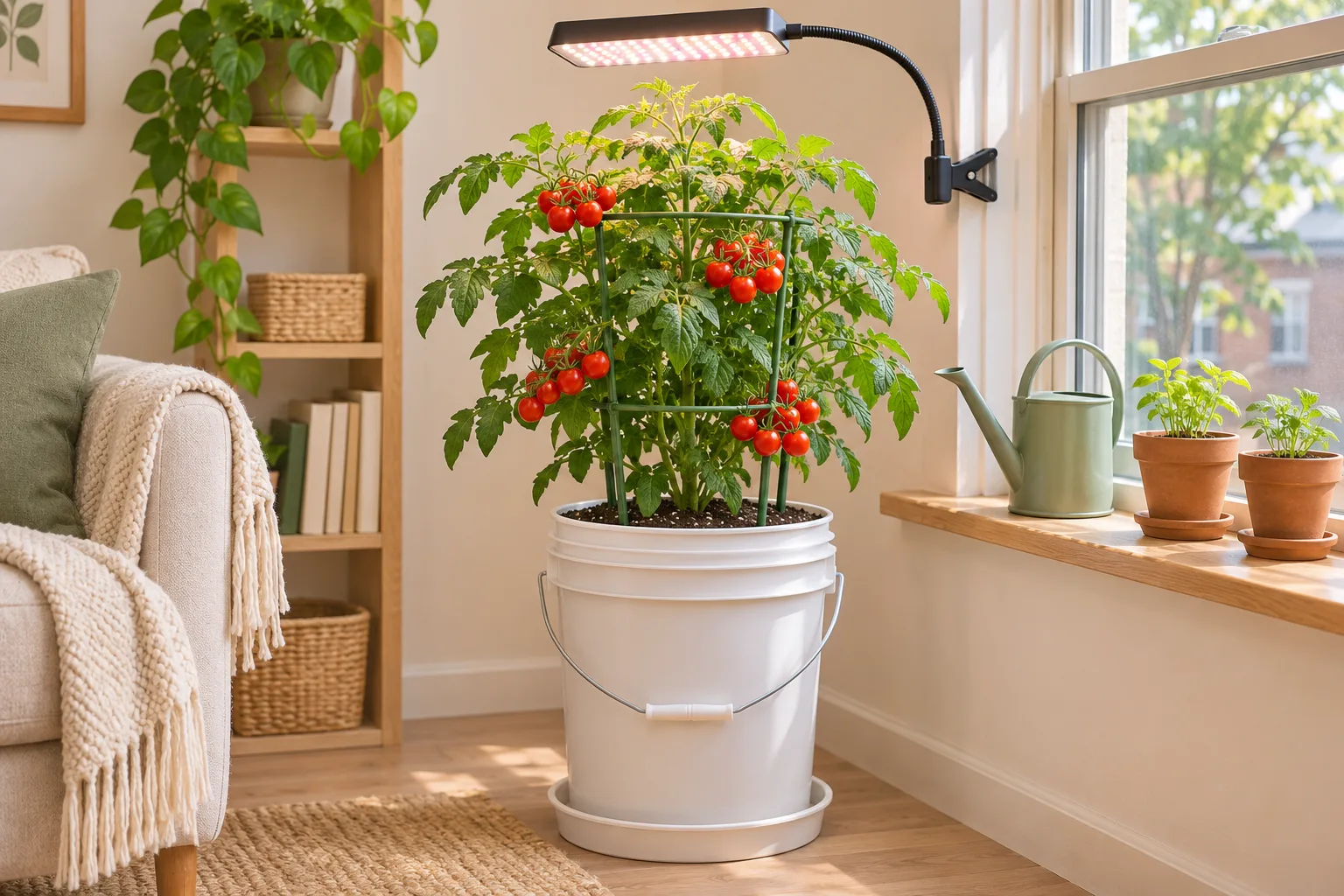
- A container with drainage holes. A 5-gallon bucket with holes drilled in the bottom works (Clemson Extension). Extension guides generally suggest 4–5 gallons for a full-size plant
- A saucer or tray to catch water
- Fresh soilless potting mix (peat or coir plus perlite or vermiculite), not garden soil, which compacts and drains poorly (University of New Hampshire Extension)
- A light. A bright south-facing window helps, but a grow light is more reliable in winter. Fluorescent shop lights work well, and broad-spectrum LED lights are another good option (University of Maryland Extension)
- An outlet timer
- A fertilizer for fruiting vegetables
- A small soft brush, or an electric toothbrush, for pollination
- A small cage or stake for plants that flop over
Step-by-step: how to grow tomatoes indoors
Step 1: Start seeds (or buy a starter plant)
Fill small pots with moist potting mix and sow seeds about ¼ inch deep. Seeds sprout best in potting mix at 65–75°F (University of Maryland Extension). If you'd rather skip this step, a small nursery plant works too. Seedlings stay in small pots for about 5 to 6 weeks, until they are stocky 8- to 10-inch plants, per the same guide.
Step 2: Give seedlings strong light right away
Keep fluorescent or LED lights 2 to 6 inches above the seedlings and run them 14 to 16 hours a day on an outlet timer (University of Maryland Extension). Raise the light as the plants grow. Check the light's instructions for heat output so the leaves don't scorch.
Step 3: Pot up into the final container
When the first true leaves appear, move seedlings to larger pots, burying most of the stem. Buried stem grows roots, leaving only 2 or 3 sets of leaves above the soil (University of Maryland Extension). When the plant outgrows its starter pot, move it to its final 4–5 gallon container. Fill it with fresh potting mix and set the plant in a bright spot.
Step 4: Light the mature plant
Tomatoes need at least 6 hours of direct light a day and prefer 8 to 10 (University of Maryland Extension). Most windows in winter fall short, so add a grow light over the plant and keep it on a timer. Follow your light's manufacturer instructions for distance, since the 2–6 inch rule above is for seedlings.
Step 5: Water and feed
Water thoroughly when the top 2 inches of potting mix are dry, until water drains from the bottom, and empty the saucer afterwards (Clemson Extension). Pots dry out fast, so check them daily. Clemson suggests timed-release fertilizer at planting, then a soluble fertilizer weekly starting two weeks later, following the product label. Too much nitrogen gives you leaves instead of fruit (University of Illinois Extension).
Step 6: Keep the room comfortable
Tomato flower and fruit production drops when temperatures fall below 55°F or rise above 95°F (University of Maryland Extension). Keep the plant away from cold windowsills at night and from heater vents. A small fan on low gives gentle air movement.
Step 7: Hand-pollinate the flowers
Tomato flowers contain both male and female parts, so they only need a little air movement to self-pollinate, but indoors there is no wind or bees. Colorado State University Extension suggests lightly tapping the flower, or using a small brush, a cotton swab or an electric toothbrush (Colorado State University Extension). Do this every day or two while flowers are open. University of Illinois Extension says that good light and hand pollination are the keys to growing tomatoes indoors (University of Illinois Extension).
Step 8: Support and harvest
Support the plant with a small cage or stake. Pick fruit once it is fully coloured. Tomatoes ripen at their highest quality on healthy vines at a daily average temperature of about 75°F (University of Illinois Extension).
Common problems
| Problem | Likely cause | Fix |
|---|---|---|
| Flowers drop without fruit | Too cold or hot, uneven watering, or no pollination | Keep the room between about 55°F and 95°F, water evenly, hand-pollinate |
| Tall, pale, floppy growth | Not enough light | Add or lower a grow light |
| Lots of leaves, few flowers | Too much nitrogen | Switch to a fertilizer made for fruiting vegetables |
| Dark patch on the bottom of fruit | Blossom end rot, which extension services link to low calcium | Water evenly (see the note below) |
For the blossom end rot row, Illinois Extension notes that eggshells only help once they have decomposed, and most soils already have enough calcium; Maryland suggests gypsum mixed into soil if calcium is low.
If you like growing things through the colder months, see our guide to a budget winter garden.
Frequently asked questions
Can you grow tomatoes indoors all year?
Yes, if you can give them enough light and keep the room warm enough. In winter a grow light on a timer is usually what makes the difference.
How much light do indoor tomatoes need?
At least 6 hours of direct light a day, and preferably 8 to 10, according to University of Maryland Extension. Grow lights fill the gap when windows don't provide it.
What size pot do indoor tomatoes need?
Extension guides suggest 4–5 gallons for a full-size container tomato, such as a 5-gallon bucket with drainage holes.
Do I have to pollinate tomatoes by hand indoors?
It helps. Tomatoes can self-pollinate with a little air movement, but indoors there's no wind or bees, so tapping flowers or using a small brush or electric toothbrush improves the odds of fruit.
Which tomato varieties are best indoors?
Compact determinate and dwarf types such as Tiny Tim, Tumbling Tom, Patio Choice Yellow, and Micro-Tom.
Sources
- University of Maryland Extension: Growing Tomatoes in a Home Garden
- University of Maryland Extension: Starting Vegetable Seeds Indoors
- University of Maryland Extension: Poor Blossom and Fruit Set of Vegetables
- University of Illinois Extension: How to Grow Tomatoes
- University of Illinois Extension: Dwarf Tomatoes Save Space
- University of New Hampshire Extension: What is the best way to grow tomatoes in a container?
- Clemson Cooperative Extension: Tomatoes in Containers
- Colorado State University Extension (Pueblo County): Hand Pollination
- ASPCA: Toxic and Non-Toxic Plants
More garden ideas
- Garden
DIY Garden Chair Bird Bath: Upcycle an Old Chair
DIY garden chair bird bath turns an old chair into a shallow, bird-safe water station. Easy afternoon project, about $5–$25 plus paint drying time.
- Garden
How to Propagate String of Turtles (Easy Cuttings)
Learn how to propagate string of turtles from stem cuttings: what to cut, how to root them, how long it takes and how to fix rot. Easy and cheap.
- Garden
How to Propagate Poinsettia from Cuttings (and When)
Learn how to propagate poinsettia from stem cuttings: when to take them, how to root them in 3 to 4 weeks, and how to check for plant patents.